
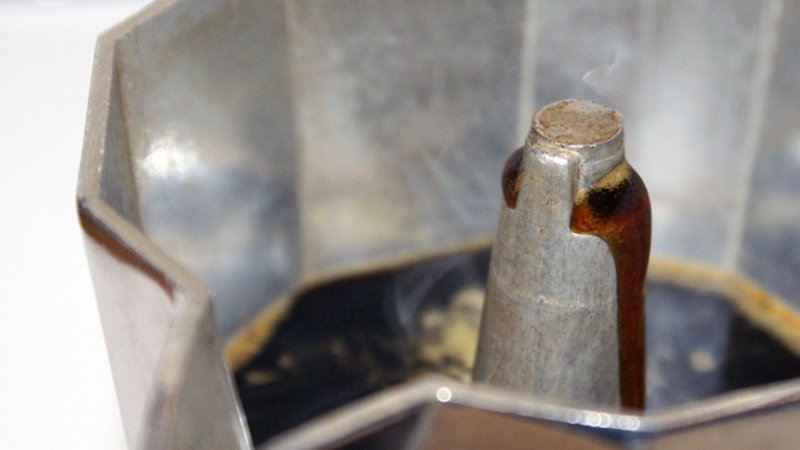
The moka pot is one of the oldest and most iconic methods for brewing coffee. It’s an affordable way to quickly make a robust beverage.
History of the Moka Pot
The moka pot was invented at the beginning of the last century, when preparing quality coffee at home was a rather trying affair. Residential espresso machines just couldn’t keep up with commercial models. It’s in this context that the moka’s inventor, an Italian man by the name of Alfonso Bialetti, sought to offer a tasty and practical alternative for home use. His story is actually quite interesting.
Bialetti opened an aluminum parts workshop in Crusinallo, Italy, in 1919, after having learnt the trade over ten years in Paris. One day, he bumped into some women doing their laundry in a peculiar way not far from his workshop, they were using a chimney to push up soapy water from a boiler in the middle of a pool filled with clothes to wash. This system inspired Bialetti to create his little moka pot out of aluminum, a particularly modern material at the time. Thus, the Moka Express was born in 1933.
Nowadays, there’s a whole slew of moka pots on sale, though Bialetti remains the industry leader. Coffee pots can hold between one and eighteen ‘cups’ (servings) of coffee, and are made of aluminum or stainless steel.
In fact, the contrast between these two materials is subject to quite a little debate in the coffee world. Some love the authentic side of aluminum, the original material from which the moka pot was made, which also happens to change coffee’s taste over time due to the pot’s oxidation. Others prefer stainless steel, since it never alters the coffee’s taste, is more durable, and is more heat resistant.
The moka pot is obviously very appealing for home use due to its efficiency and the remarkable quality of the coffee it can make. But it can also be very practical for camping! Indeed, you can make coffee simply by placing the pot directly onto a fire. However, make sure you use a stainless-steel model if you’re doing this, since it’s more resistant to heat than aluminum.
Taste Profile
The moka pot makes coffee that’s similar to espresso. Its taste remains slightly less distinct, but it’s still rather impressive for a system that doesn’t produce the same pressure.
The coffee’s texture is slightly less smooth than espresso, notably due to the absence of crema. However, using perfectly ground coffee can actually yield a small layer of crema.
How to Use a Moka Pot
Once you understand how to use the device, you can make coffee with it in less than two minutes. The longest part is waiting for the water to boil and the coffee to brew.
-
Fill the lower receptacle with cold water until it reaches just under the valve.
-
Insert the filter into this receptacle and add your coffee grounds. Don’t put anything into the top part, since that’s where the brewed coffee will end up.
-
Put the pot onto the stove at medium heat and wait. Once the water starts to boil, it will be pushed upwards, pass through the coffee grounds in the filter, and fill the upper receptacle.
-
Remove it from the stove once you hear the coffee flowing at a constant rate.
-
Pour and enjoy.
You should opt for a rather fine grind when you use a moka pot. It’s generally a little coarser than what’s used for espresso, but not as coarse as for a filter coffee machine. If you need to choose between filter and espresso grinds, go for the latter.
Maintaining and Cleaning a Moka Pot
Coffee oils will accumulate inside the upper receptacle over time. We recommend simply rinsing the pot with hot water. However, if you really want to clean it (which we advise doing occasionally), you should know that only stainless-steel models can be cleaned using specific detergent (which also contributes to these pots’ longevity). Aluminum models can be cleaned using regular soap, which isn’t ideal.
The seal ring should also be changed from time to time. Once it turns black and shrinks, then you’ll know it’s time to get another one!






Share:
From Tree to Cup: Coffee’s Journey from A to Z
Cuban Coffee Taste Profiles