
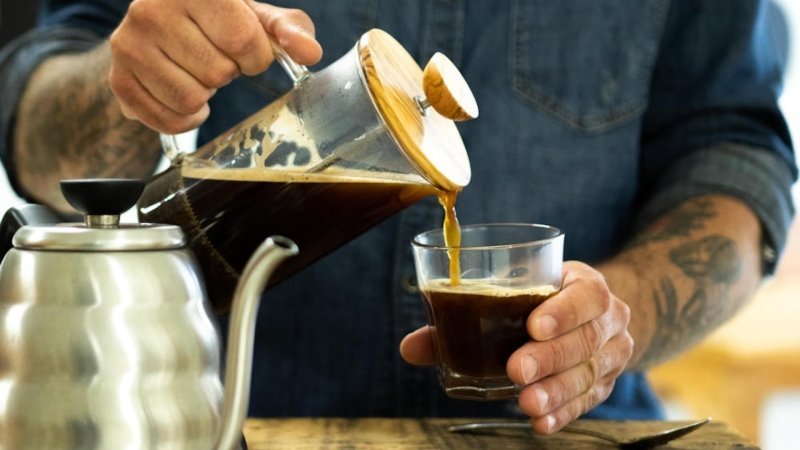
The French press, also called a cafetière or Bodum (named after the company that manufactures it), is very practical, easy to use, and brews coffee with a pure, mild, and rich taste.
History of the French press
The French press's origins (aka cafetière or coffee press) are rather unclear. What we do know is that the modern marketed version of the system can be attributed to Milanese designer Attilio Calimani, who filed his patent for it in 1929. But there were several versions of the machine before this milestone. There are numerous stories that come up again and again about French people or Parisians in the mid-19th century that had sought solutions for eliminating the residue left in their coffee cups. Some of the oldest written evidence we have of the coffee press's invention date to 1852!
That said, the modern version of the French press presents a number of advantages: it is extremely simple to use, easily cleaned, can produce high quality coffee, and – most importantly – yields a delicious beverage.
As a result, it is very practical not only for coffee enthusiasts who don't have much time in the morning, and who want a highly caffeinated drink, but also for campers who want to prepare a decent cup of coffee in the middle of nowhere.
Flavour profile
First, given that the French press provides no barrier between water and coffee, meaning that both are constantly in contact, you get a very bold, rich and mild taste, all at once. This means that you will easily taste both the qualities and shortcomings of a given coffee in your cup. Therefore, you should be careful in choosing the coffee blend you use.
Next, taste variations can be near infinite, since you control almost all the variables affecting your coffee's flavours: grind, bean choice, brew time, water temperature... experiment and see what you like best! The only drawback to keep in mind is that your coffee will become more bitter the longer you let it brew.
How to use a French press
You can always let your coffee brew in the simplest way with a French press: add coffee and water, let it brew, and press. However, you can also opt for a more elaborate process that will allow you to get the best out of your cafetière.
Step 1
Drop 2 to 3 tablespoons of (coarsely) ground filter coffee into the bottom of the press, or, depending on how big the model is, use a 1:10 ratio. That is, add 10 parts water to 1 part coffee. You can adjust the amount of coffee to change its intensity.

Step 2
Pour a little hot water (95 °C) in a circular motion until about half the press is filled. Wait about 40 seconds. This step, called the bloom, is meant to free up the gases trapped in the coffee.

Step 3
Pour water again until it reaches just above the metal ring, or ¾ of the press.

Step 4
Using a spoon, stir the mix until you get consistent surface coffee foam. Place the cover on the press and let it brew for 6 minutes. Once again, you can adjust brew time according to the strength desired.

Step 5
Slowly press down on the piston until it bottoms out.

Step 6
Pour and enjoy!

Keep in mind that you can easily find various coffee-to-water ratios on the Internet if you prefer using a scale, in order to get the most precise measurements possible. That is, you can place your French press on a scale and go through all these steps by measuring ingredient weight rather than volume.
You can also use your French press to make cold brew coffee! Follow the same steps as those for making hot coffee, but use cold instead of hot water. Then, let it sit for about 12 hours, press, and voilà!
Source used in writing this article:
Daniel Engber: https://www.nytimes.com/2014/06/01/magazine/who-made-that-french-press.html





Share:
How to Make the Perfect Cappuccino Foam?
Chemex: How Does it Work?